
Saturday, September 25, 2010
Where Good Ideas Come From
Saw this great video today on Boing Boing from Steve Johnson whose new book "Where Good Ideas Come From" has just come out, and from this video it looks like it is a pretty good read. I like what he says about how today we have more and more opportunities to connect with each other and make great ideas because of the internet. Very cute video too, you know I always love a good visual. A good little video to watch if you have time.

Friday, September 24, 2010
Making fun of Hipsters is funny
Actually one of my favorite things lately is anyone who pokes fun at Hipsters. Thanks to Gillian for sending this one my way. In the UK they must refer to them as dickheads, pretty hilarious...
Monday, September 20, 2010
Henrique Oliveira
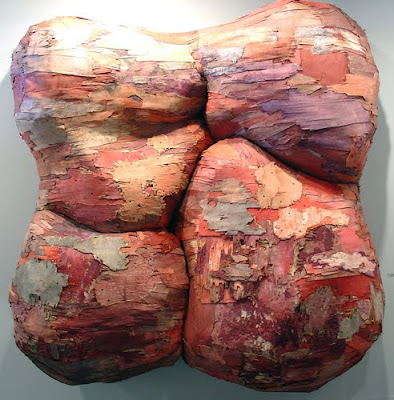
These are so of my favorite images this week! Henrique Oliveira is a Brazilian artist who uses reclaimed wood to create large wooden amorphous installations. To me, these installations look like the body. I see fat bellies, organs, and breasts. I LOVE this work.
Oliveira finds his reclaimed wood, which he calls Tapumes, which is the portugese word for this thrown out wood and also the name of this series, then he tints the wood, bends it and shapes it into these forms. It is very lovely to look at in the images. I'd love to see it in person, but I bet I couldn't resist touching it!
In one of his more recent works the installations are starting to seep out of the building. How very, very cool.
 Tapumes

 Tapumes
2009
Rice Gallery, Houston
 Tapumes
 Artist preparing wood for installation
 Pit
Pit
 Tapumes - Casa dos Leoes
2009
VII Bienal do Meroscul, Porto Alegre
Oliveira finds his reclaimed wood, which he calls Tapumes, which is the portugese word for this thrown out wood and also the name of this series, then he tints the wood, bends it and shapes it into these forms. It is very lovely to look at in the images. I'd love to see it in person, but I bet I couldn't resist touching it!
In one of his more recent works the installations are starting to seep out of the building. How very, very cool.
 Tapumes
2008
Galerie Vallois, Paris
Galerie Vallois, Paris

 Tapumes
2009
Rice Gallery, Houston
 Tapumes
2006
Sao Paulo Cultural Center
Sao Paulo Cultural Center
 Artist preparing wood for installation
 Pit
Pit2008
Object
Object
 Tapumes - Casa dos Leoes
2009
VII Bienal do Meroscul, Porto Alegre


Wednesday, September 15, 2010
Reproductive Identity
Over this summer I finished reading this amazing collection of essays, in a book titled, Writing on the body: Female Embodiment and Feminist Theory, edited by Katie Conboy, Nadia Medina, and Sarah Stanbury.

An essay titled, "Medical Metaphors of Women's Bodies: Menstration and Menopause" by Emily Martin, discusses how women are identified by their reproductive ability, whether that be during their fruitful years or not. I found this essay to be not only biologically specific and informative, for someone who has never studied medicine, but also parallel some commonly presented notions of desire based on a woman's ability to reproduce.
Although this book is full of amazing perspectives on seeing the female body, I wanted to post about it because I had this amazing experience in Thailand and China over the summer that relates to this text. In several Buddhist temples in both Thailand and China there are these enormous dog-like creatures that guard the entrance ways (the ones in Thailand were gifts from the Chinese Imperial government).


There is always one creature on the left of the doorway and one on the right of the doorway. I didn't even really notice at first that they were different (there is SO much to look at in these places) until our tour guide asked the question, "Can you tell which one is the boy and which one is the girl?" After inspecting them carefully I responded, "There is a penis and testicles on that one, so that one must be male." To which our tour guide responded "We don't look at things like that," so the delicately carved anatomy that someone spent countless hours articulating doesn't matter. What he pointed out was that in both figures the animal has one paw rested on an object, in the male statue the paw is rested on a ball, a symbol of freedom and fun, while the female counterpart has her paw rested on a baby dog-like creature.


So we disregard anatomy and look instead for a symbol of woman's reproductive ability. I found this to be extremely interesting, especially since I had just read about it. And it continued, I saw this creature everywhere, and the female animal was always confirmed as female by her ability to reproduce a child.


An essay titled, "Medical Metaphors of Women's Bodies: Menstration and Menopause" by Emily Martin, discusses how women are identified by their reproductive ability, whether that be during their fruitful years or not. I found this essay to be not only biologically specific and informative, for someone who has never studied medicine, but also parallel some commonly presented notions of desire based on a woman's ability to reproduce.
Although this book is full of amazing perspectives on seeing the female body, I wanted to post about it because I had this amazing experience in Thailand and China over the summer that relates to this text. In several Buddhist temples in both Thailand and China there are these enormous dog-like creatures that guard the entrance ways (the ones in Thailand were gifts from the Chinese Imperial government).


There is always one creature on the left of the doorway and one on the right of the doorway. I didn't even really notice at first that they were different (there is SO much to look at in these places) until our tour guide asked the question, "Can you tell which one is the boy and which one is the girl?" After inspecting them carefully I responded, "There is a penis and testicles on that one, so that one must be male." To which our tour guide responded "We don't look at things like that," so the delicately carved anatomy that someone spent countless hours articulating doesn't matter. What he pointed out was that in both figures the animal has one paw rested on an object, in the male statue the paw is rested on a ball, a symbol of freedom and fun, while the female counterpart has her paw rested on a baby dog-like creature.



So we disregard anatomy and look instead for a symbol of woman's reproductive ability. I found this to be extremely interesting, especially since I had just read about it. And it continued, I saw this creature everywhere, and the female animal was always confirmed as female by her ability to reproduce a child.

Monday, September 6, 2010
The Impossible Project
For those of you that know me, you know that I am a huge fan of Polaroid instant film. If you are also one of the many lovers of Polaroids, you know that in late 2008, Polaroid closed its last factory producing instant film and has left many users scrambling to gather the reserves of film that still exist.
I recently discovered the Impossible Project, a team of former Polaroid employees who have dedicated themselves to the re-production of instant analog film, and have learned a little more about the Impossible Project story.


So the story goes that Florian Kaps, an instant film super fan, was in a Netherlands pub drinking a beer with a manager of a nearby Polaroid factory that had just been closed. Outraged and motivated by the fact that $130 million dollars of Polaroid production equipment was set to be destroyed in just a few days Kaps created what seemed Impossible. Kaps invested and acquired not just the equipment and factory needed to save Polaroid, but hired a group of ten former Polaroid employees who were more than happy to work in the struggle to save instant film.
The Impossible Project research facility is in Enschede, Netherlands, in the north building of one of the last Polaroid plants and has taken on the almost impossible task of reinventing analog instant film. These heros face the challenge of replacing and upgrading expensive chemical components which are out of production and no longer available.
Polaroid, which gained its iconic reputation under scientist and inventor Edwin Land, released its first analog instant film in 1948 and ran into both monetary and strategic problems when Land passed away in 1991 at age 81.
The Impossible Project has set its goals high and plans to create several new analog instant film products, the first of which, the PX Silver Shade System, has already been released. I have had very little experience with this new monochrome system, but what I can tell you is that it is very sensitive to light and temperature, which yields a WIDE variety of results. Can I also just clear up now that SHAKING A POLAROID PICTURE IS THE WORST THING YOU CAN DO!
Here are a few photos recently taken at my iron forging workshop with Impossible Project film. (Channel old shop photos from early 1900s). Thank you to Valentina for taking these lovely photos of us!


Impossible says that this new film has some 29 layers and uses 13 new chemicals, and while I don't know too much about photography, that sounds like they have gone through a lot of work to make these photos amazing. Grant Hamilton is shooting a documentary about Polaroid that is scheduled to be released sometime this year.
Sarah Gilbert is a freelance writer and blogger who has an excellent post about instant film's undecided future, The Impossible Project's current struggles with both it's research and it's somewhat tumultuous relationship with Polaroid. She interviewed Grant Hamilton earlier this year and noted that one of the biggest challenges to instant film is the waterproof layer on the top of each piece of film.
"Each photograph is its own darkroom...and needs this layer that goes from completely opaque to completely transparent in about a minute, once it is exposed to light." When you shake your Polaroid picture, you are jiggling one of the most complex pieces of technology around. "The idea that film is somehow low-tech is completely wrong."
Thank you to Florian Kaps, Grant Hamilton, Impossible Project Team, Sarah Gilbert and most of all to Edwin Land. Buy Polaroid film. Shoot Instant. Keep Polaroid alive. Share.
I recently discovered the Impossible Project, a team of former Polaroid employees who have dedicated themselves to the re-production of instant analog film, and have learned a little more about the Impossible Project story.


So the story goes that Florian Kaps, an instant film super fan, was in a Netherlands pub drinking a beer with a manager of a nearby Polaroid factory that had just been closed. Outraged and motivated by the fact that $130 million dollars of Polaroid production equipment was set to be destroyed in just a few days Kaps created what seemed Impossible. Kaps invested and acquired not just the equipment and factory needed to save Polaroid, but hired a group of ten former Polaroid employees who were more than happy to work in the struggle to save instant film.
The Impossible Project research facility is in Enschede, Netherlands, in the north building of one of the last Polaroid plants and has taken on the almost impossible task of reinventing analog instant film. These heros face the challenge of replacing and upgrading expensive chemical components which are out of production and no longer available.
Polaroid, which gained its iconic reputation under scientist and inventor Edwin Land, released its first analog instant film in 1948 and ran into both monetary and strategic problems when Land passed away in 1991 at age 81.
The Impossible Project has set its goals high and plans to create several new analog instant film products, the first of which, the PX Silver Shade System, has already been released. I have had very little experience with this new monochrome system, but what I can tell you is that it is very sensitive to light and temperature, which yields a WIDE variety of results. Can I also just clear up now that SHAKING A POLAROID PICTURE IS THE WORST THING YOU CAN DO!
Here are a few photos recently taken at my iron forging workshop with Impossible Project film. (Channel old shop photos from early 1900s). Thank you to Valentina for taking these lovely photos of us!


Impossible says that this new film has some 29 layers and uses 13 new chemicals, and while I don't know too much about photography, that sounds like they have gone through a lot of work to make these photos amazing. Grant Hamilton is shooting a documentary about Polaroid that is scheduled to be released sometime this year.
Sarah Gilbert is a freelance writer and blogger who has an excellent post about instant film's undecided future, The Impossible Project's current struggles with both it's research and it's somewhat tumultuous relationship with Polaroid. She interviewed Grant Hamilton earlier this year and noted that one of the biggest challenges to instant film is the waterproof layer on the top of each piece of film.
"Each photograph is its own darkroom...and needs this layer that goes from completely opaque to completely transparent in about a minute, once it is exposed to light." When you shake your Polaroid picture, you are jiggling one of the most complex pieces of technology around. "The idea that film is somehow low-tech is completely wrong."
Stephanie Metz


 While at Penland I stopped by the Penland Gallery and included in the group show currently on exhibit, All This Happened, More or Less, is the work of Stephanie Metz. I love this work! I love how Metz takes the notion of the teddy bear and asks us to reconsider the fantasy of this creature by putting it into physical terms. This is how we preserve "real" things like human and animal bodies, so why not the teddy bear?
 The "specimens" are made from densely felted wool that is shaped into the bones or cadavers of a teddy bear. In one piece she shows the fetal development of the teddy bear. Illustrating a developing fetus can be risky, yet using the imaginary teddy bear makes it less real somehow, but still walks a very delicate line. Very, very good.
I also really enjoy her presentation of the work. In fact, her decision to present the teddy bear specimen in a glass jar filled with liquid is absolutely brilliant! I laughed out loud when I saw this, and the two other ladies in the room came over and had a little giggle too. Very well made and very smart. Thank you very much Stephanie. I know I've seen this work before, but didn't keep up on it. Well, I'm going to keep an eye on what you are up to now!
Stephanie also teaches classes on her felting which you can find on her website here, and images of her teddy bear fetus growth are on her ETSY page here.
Sunday, September 5, 2010
Elizabeth Brim

Touring of Blacksmith shops in and around Penland would not be complete without a visit to the shop of Elizabeth Brim. Brim is not only a splendid time to chat with, she is a leader in the field, constantly contributing back by way of teaching and mentoring and a role model for all women in the field. In her work she makes lacy, frilly and soft (looking) objects from steel. How cool!


 These flowers are extras from a commission where she made a full size magnolia tree in downtown Spruce Pine, not too far from her studio.


Brim was ready for us! She had all her goodies laid out, objects, tons of pictures, samples..you name it! She also had lots of stories to share with us and, of course, turned her power hammer on for us. I especially loved her power hammer because it is so much different than any of the others we saw. Thanks E.B.!!
Zack Noble
At one point during my iron workshop at Penland, we pulled our noses out of the coal, got cleaned up, left the mountain and visited Zack Noble and his studio. Zack was very generous to have us all in his space and to show us around for so long. He showed us what he was experimenting with on his power hammer, some architectural drawings of a new gate he is working on and just let us wonder around his space. What a cool place! So many exciting things lying around...


 Zack was awarded a core fellowship at Penland and since has been living and working at his studio in Bakersville, which is not far away at all. I am told he is best known for his innovative forging style. He has a long list of examples of his work on his very cool website, including my personal favorite, a railing he did in Telluride, Colorado.
Also on his website are a few videos that show some of his processes, my favorite is the tube squashing. I can't wait to try that out sometime!
 This little sample is what Zack was working on when we invaded on him that sunny Wednesday afternoon.
 Before we left, Zack was kind enough to turn on his Lobdell electro-pneumatic nazel power hammer for us. This thing is the real deal. The beauty of it is that it can work really delicately or powerfully, just depends on how much you push it. I love that this is part of the blacksmith's workshop! The big 'ol machines were made for industry back in the industrial revolution, and now they have made their way into artisan hands. Love it! Look at this old picture I found of Zack's model....Also check out the video of him turning on his hammer for us. Thanks Zack!
Subscribe to:
Posts (Atom)